The Caine’s chronic disrepair
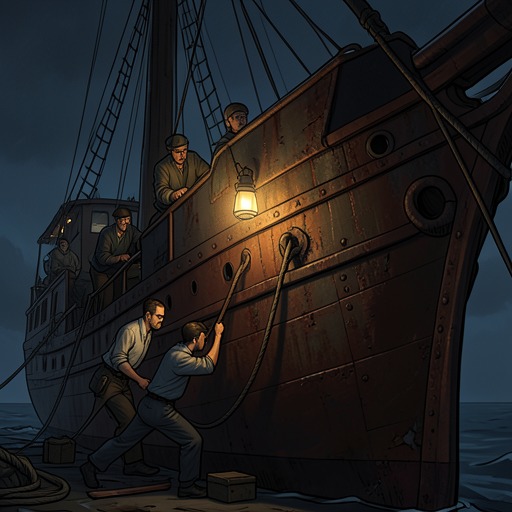
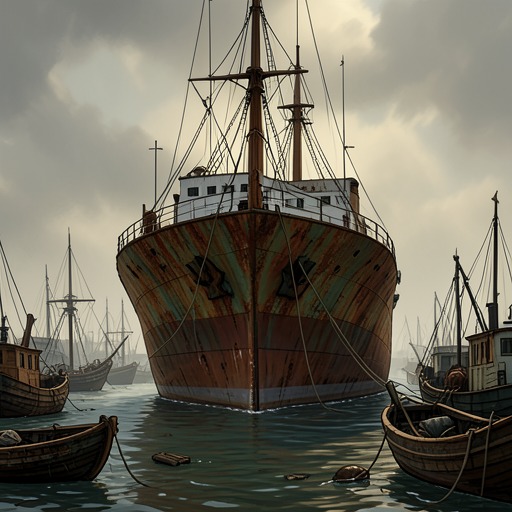
The Caine MutinyThe USS Caine’s chronic disrepair shapes the ship’s appearance, its crew’s living conditions, and the limits of its usefulness. The vessel has spent the war moving supplies, personnel, and equipment, escorting convoys, and undertaking other assignments rather than serving only as a minesweeper. Its deterioration is therefore not incidental background: it is the accumulated cost of sustained service, made visible in worn surfaces, cramped spaces, obsolete machinery, and recurring maintenance problems. The novel also expressly identifies the ship and its events as fictional, and warns that operational details have been altered; the Caine’s condition belongs to that invented historical setting, not to a claim about an actual vessel.
A Ship Worn by Its Work
The Caine’s record of service helps explain why it is run down. Its duties have included carrying aviation gasoline for Marine fliers at Henderson Field, transporting torpedoes, moving troops, and serving as a convoy escort, supply vessel, and mail carrier. The variety and reach of this work place the ship within the practical machinery of the Pacific war, but they also help account for its battered state. When Willie Keith arrives aboard, the ship is already presented as an old vessel whose condition has been shaped by years of demanding, changeable assignments.
Captain de Vriess describes the class’s physical and mechanical shortcomings to his successor. The ships roll and pitch heavily, their power plants are failing, and their machinery is obsolete. Their crews are crowded, and the fire-room arrangement requires the engineering crew to work under air pressure, a condition de Vriess says could make a blowback fatal. His account makes the Caine’s poor condition more than a matter of untidy paint: it encompasses the ship’s basic capacity to operate and the hazards built into its working spaces. He also observes that the crews know what kind of ship they have and nevertheless often remain rather than seek transfers, suggesting a durable bond between sailors and a difficult assignment without making the ship’s defects seem harmless.
Living Conditions and Daily Routine
The Caine’s deterioration reaches into ordinary life aboard. Willie’s first quarters are a small metal clipping shack, about seven feet high, six feet long, and three feet wide. A bunk has been welded close to the deck, with the fresh weld still visible, and the temperature inside is about 105 degrees. The cramped, overheated space is also used to store ammunition-related equipment. It is a practical accommodation, but one that gives the new officer little separation between sleeping quarters and the ship’s work.
The enlisted quarters offer a different view of the same conditions. When Willie goes below to check reveille, he finds sailors slow to rise and a deck littered with cigarette ends, papers, clothing, and old food scraps. The master-at-arms has to move between the bunks to rouse the men. Willie withdraws, ashamed of intruding on their wretched living space. The scene connects poor maintenance with the human experience of the ship: dirt and crowding are not simply visible defects in the vessel but part of the environment in which its crew sleeps and works.
The ship’s condition is reinforced by the rhythm of service. During rough weather, Willie moves between bridge watches, coding, publication corrections, meals, and sleep in the clipping shack, which is repeatedly interrupted. The account makes routine itself feel constricted: work and rest cycle through the same rolling vessel, while administrative tasks continue alongside watch duty. Later, during extended escort service, days dissolve into weeks of watches, logs, monthly reports, audits, heat, rain, and changing seas. This repetition shows how prolonged service wears down time aboard as well as machinery; the Caine’s disrepair is lived through a routine that leaves little room for recovery.
Comparison and the Limits of Shipboard Order
The contrast with the USS Moulton demonstrates that the Caine’s appearance is not simply an unavoidable feature of the destroyer-minesweeper design. The ships are structurally identical, yet the Moulton has no rust or green primer patches; its bulwarks and decks are uniformly gray, its ladder cording is new, and its life-line wrapping is tightly sewn and unpainted. Its sailors are clean and neatly dressed. Willie recognizes that a ship of this class does not have to look like the Caine. The comparison makes the Caine’s condition distinctive: the same general structure can be maintained to a markedly different standard.
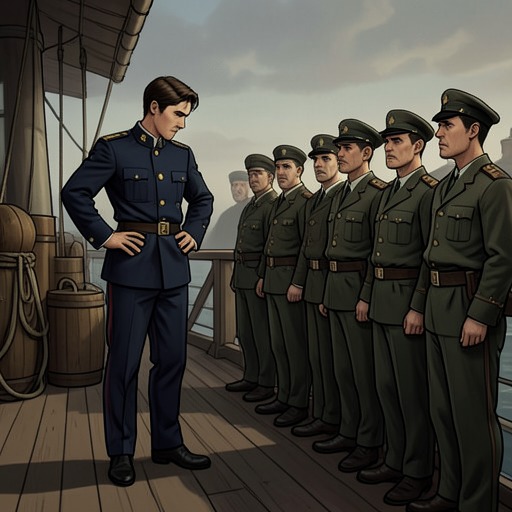
Disrepair also persists despite the captain’s rules. After a cigarette butt is found in a scupper, Queeg cancels the crew’s liberty and the main deck is kept swept for a short period. Once the Caine sails, the broader deck returns to its former state, although a small area near the captain’s cabin and the wardroom remains cleaned. The crew’s compliance follows the captain’s immediate visibility rather than transforming the ship as a whole. The episode connects physical disorder with a divided shipboard order: rules can produce a maintained patch, but they do not by themselves repair the vessel or establish consistent care throughout it.
Operational Consequences and Narrative Significance
The Caine’s condition remains relevant even as the larger war changes. In early 1944, a vast fleet leaves Hawaii for the operation at Kwajalein, placing the old minesweeper among forces whose movement depends on intricate coordination. Later, the Caine’s assignment to the Seventh Fleet brings a grinding sequence of escort voyages among islands and ports. At a destroyer tender in Funafuti Atoll, Willie can use the tender’s communications office to have fleet messages decoded and mimeographed, reducing a substantial burden on the Caine’s communicators. The contrast between the tender’s extensive services and the Caine’s overworked communications staff shows that the ship’s limitations include not only its hull and machinery but also the labor required to keep it functioning.
Near the end of the war, the Caine finally sweeps a mine in the China Sea, a concrete instance of the work its name and class imply. Yet the ship is not included in the destroyer-minesweeper force ordered to prepare for the sweep of Tokyo harbor. Its pumps have been repaired, but the operations officer remains concerned that another breakdown en route would leave a ship with only twelve knots of power facing typhoon season. Willie Keith and Tom Keefer accept the decision with rueful disappointment as they watch the other minesweepers depart from Buckner Bay. The repaired pumps offer a temporary improvement, not proof that the ship has recovered its operational reliability. The Caine’s chronic disrepair thus persists to the end as both a material burden and a limit on participation: years of service have made the ship useful, but not dependable enough for every final assignment.